


There’s a fiftieth anniversary party in Ann Patchett’s Whistler, and a man named Eddie gets up to give a toast, because fifty years earlier he was the best man at the wedding being celebrated.
I’ve listened to that toast four times now. I would like it printed and framed and hung on a wall in my house, which isn’t a thing I’ve ever wanted to do with a paragraph before.
“There is so much randomness to youth. The person assigned to share your room becomes your friend, the girl you pass on your way out the door becomes your wife, and from these random encounters our entire lives are built, four beautiful children came into the world, and they in turn found the people they were meant to spend their lives with. There are ten grandchildren now. Ten new people who in part owe their lives on earth to Skip admitting that there was something deeply familiar about the girl he had passed, and trusting himself enough to turn around and go back and see who she was.”
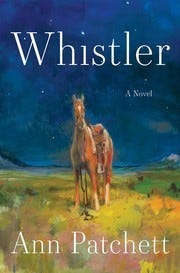
Whistler, Ann Patchett
The math nobody does
What the toast does, and what I couldn’t stop turning over for two days afterward, is that it counts forward.
We don’t do that, we count backward. That’s the entire shape of how people think about family, and of the ancestry industry, a multibillion-dollar business built on looking behind you. You find out you had a great-great-grandmother who came over on a boat, or that there’s Irish in there somewhere. It’s interesting in the way a map is interesting, and it’s completely safe, because everyone on that chart is already done.
Nobody sits down and counts in the other direction and says: two people saw each other across a room one time, and here is the number of human beings currently walking around on this planet as a direct result.
But that’s the real number, the one with actual people in it, people who have jobs and allergies and opinions about cilantro, people who will be here after everyone at that party is gone.
Eddie stands up and says, essentially, I watched two people meet, I was standing right there, and now look how many of you there are.
The roommate
Read that first clause again, because I went past it three times before it caught me.
The person assigned to share your room becomes your friend.
Eddie is in his own toast. He’s the roommate. Somebody in an office put two boys in a room together, and out of that one piece of paperwork came the friendship that had Eddie standing in the doorway on the day Skip turned around, which made him the best man at the wedding, which put him on his feet fifty years later counting grandchildren out loud.
The same mechanism produced the marriage and produced the man who would spend his entire life standing just outside it, all from one list and one afternoon of nobody thinking very hard about it.
Standing right there
The part that undid me is that Eddie was in the room.
He didn’t hear about it later or get told the story at Thanksgiving forty years on. He was physically present at the moment two strangers became not-strangers, and he had no way of knowing, and nobody ever has any way of knowing, that he was watching the first thirty seconds of an entire branch of humans.
You’ve been in that room, and so have I. We have all stood in a kitchen at a party while two people we knew separately met each other for the first time, and we thought nothing of it, because there’s nothing to think. It looks like nothing, indistinguishable from every other introduction that went nowhere.
What I keep getting stuck on is that if Eddie is right, the moment isn’t rare. It’s happening constantly, everywhere, and it’s invisible in real time, and it only becomes legible fifty years later, when a man who was paying attention stands up at a party and says it out loud.
The part that turns the toast inside out
Spoilers for the next three paragraphs. Jump ahead to the locker if you haven’t read the book and want it clean.
Eddie isn’t just the best man. Eddie loved Skip. He loved him for his entire life, quietly, in a time and a place that didn’t have room for it, and Skip is the man standing next to Polly at that fiftieth anniversary party.
So the toast is really a man standing up in front of a room, at the celebration of the marriage he was never going to be inside of, counting the human beings that marriage produced and calling the number beautiful, out loud, with a glass in his hand.
Every person he counts exists in the space where his own life didn’t get to go. He doesn’t say that, and he doesn’t need to, and the fact that Patchett lets him keep it to himself is the reason the paragraph works. And there’s no bitterness in it anywhere, which might be the most generous thing a person could possibly do.
My locker
So then I did it to myself, which I don’t recommend doing while driving.
I had a locker in high school and it was next to a boy’s locker. That’s the whole origin story, and it’s not a meet-cute or anything anybody would tell at a party.
And it wasn’t even alphabetical, which is the part that gets me. His last name started with one of the first five letters of the alphabet and mine about twelve letters later. If somebody had gone down a list in order we would have spent four years on opposite ends of a building. Whatever actually happened was closer to random. Somebody grouped us, or a senior emptied out a locker in the right hallway at the right time, and a decision nobody thought about for more than four seconds put us next to each other.
And I want to be honest about what I actually noticed at the time, because it wasn’t destiny.
He was tall. In my memory his back pocket is roughly at my eye level, which can’t possibly be true and is nevertheless how thirty years of storage has filed it. There was a specific pair of jeans he wore on football Fridays with his jersey that just really got to me.
Skip passes a girl on his way out a door, feels that there’s something deeply familiar about her, and turns around and goes back. That’s the version that gets said out loud at a party fifty years later. Mine is a fifteen year old girl standing at a locker thinking, well, that’s a very nice butt.
Both of those made families, and there are people alive because of where that locker was.
I don’t mean that metaphorically, or in an “everything happens for a reason” way, which is a sentence I’ve never been able to say with a straight face. I mean it literally. There are human beings with names and specific laughs who are on this earth, who will be on this earth long after I’m not, because of a hallway assignment made by someone whose name I never knew and who never knew mine.
I said that out loud in my car, alone, at fifty-five miles an hour, like a person coming apart.
There are three of them. My daughter is stubborn in a way that’s going to serve her extremely well and has occasionally been inconvenient for me, my middle son falls in love fast and all the way, and my youngest will argue with a wall for sport. None of the three of them would be here if somebody had gone down that locker list in alphabetical order.
The school is still standing, by the way, and so is the hallway. It looks the way it has always looked, which is like nothing at all.
And it doesn’t stop with them. My kids will presumably meet people who were standing in some kitchen or some line at a coffee shop, and in fifty years there could be a room full of people at a party who all trace back through a building in the middle of nowhere. None of them will ever know that, and none of them should have to. And I can’t wait for it. More people, their people, crowding the holiday table, and me childproofing a house again for visiting grandkids.
I’m not a person who thinks about legacy. I don’t have a plan for being remembered and I don’t want one. But this isn’t legacy, it’s population. It’s the fact that I didn’t just live a life, I made more life, and that life is going to make more life, and the whole thing keeps going in a direction I don’t get to watch.
It’s a vertigo thought, the kind you get at a railing looking down, and I don’t want it to be comforting.
Halfway
There was a best man at our wedding too.
My husband’s best friend asked in his speech, as a joke, whether he could be godfather, since our kids were obviously going to be incredible athletes. The room laughed. Nobody at a reception thinks of children as people yet. They’re a warm, vague idea for later.
He turned out to be right. What gets me is that a man made a specific claim about people who didn’t exist yet, for a laugh, and was correct. He was never the godfather. We drifted, and he isn’t in our lives now. Eddie stayed fifty years and got to stand up and do the arithmetic out loud. The man who called it at our wedding was gone long before there was anything to count.
We’ve been married twenty-five years this fall.
What I want the next twenty-five years for isn’t really the anniversary. It’s to watch who those three turn into, and what they put into the world, through what they are good at and through whoever they bring home.
Which is the same arithmetic, and I didn’t notice I was already doing it.
Twenty-five is the number, and I’ve been sitting with the fact that Eddie gives his toast at fifty.
Which means somebody could stand up at our fiftieth, if we get one, and do the same arithmetic out loud. And the number they would say is a number I can’t know yet, because most of the people in it have not happened.
I don’t know who would give that toast or who would be in the room. I only know the whole thing started because a stranger with a clipboard didn’t think about it at all.
My grandparents made it to fifty, and past it. Somebody could have stood up at their party and done Eddie’s math, and the number would have had a hole in it, because they lost one of their children. Toasts only count up. Real families subtract too, and nobody at a wedding is thinking about subtraction. I’d bet my grandparents never once did, until they had to.
My husband’s dad fought in Vietnam and came home, and his parents got married after. So my husband is here because a war didn’t take the one person it would have needed to take, and so are our three, and so is everyone they’ll ever bring to the table. Every number in a toast like Eddie’s is also a list of everything that didn’t happen to the people in it.
What the book is actually doing with this
Whistler is a novel about impermanence, and that’s the through line. A house gets sold, a body gets sick, a marriage ends, forty-five years go by without a phone call. Patchett is very steady about all of it, almost eerily calm, and I kept waiting for the book to comfort me about the losses and it mostly doesn’t.
What it does instead is put the toast in.
Which I now think is the actual argument. Everything goes, including the story you tell about it, and meanwhile, underneath all of that going, the number keeps getting bigger, because somebody met somebody and there are however many of you now. It doesn’t cancel out the impermanence. It’s just the other true thing, happening at the same time.
So go find yours, the dumb logistical accident your whole family is standing on, whether it was a seating chart, a shift schedule, a wrong bus or a roommate assignment made by a computer. What was yours? Tell me in the comments.
Format: Audiobook (narrated by Ann Patchett) | Source: Library | Rating: 5 stars
She narrates this one herself and it’s the rare case where that’s the right call. There’s a restraint in how she reads the biggest moments, a tendency to go quieter where another narrator would swell, and the toast in particular lands because she doesn’t perform it. Whether I would still be thinking about that paragraph if I had read it on a page instead of hearing it, I actually don’t know, and I find that interesting rather than annoying.
Where this one is sending me next: Tom Lake, on audio, as soon as my library has it. After two thousand words about how nobody can see forward, I’m not going to guess what it hands me.
Where else Whistler has shown up:
Whistler and the Houses I Can’t Walk Back Into (the purple room essay)
Grab a copy of Whistler. Library first, always. But if you’re buying anyway, my Bookshop.org links back indie bookstores and a sliver comes to me. No pressure.
If this one stayed with you, these two are close cousins. One is the other essay Whistler handed me, and the other is about the things we plant without knowing which ones will take root.
Whistler and the Houses I Can't Walk Back Into

I wasn't allowed to have friends over because of a cup.
Demon Copperhead and the Seeds That Take Years to Grow

Turns out, I was ready to let my business go long before I knew it.
Wow. This was a lovely read about Whistler. I love what you said about counting forward instead of counting back. There's so much talk about the "big" choices in life. Where to go school, when to get married, when to have kids, what career you'll do. And how those "big" choices can shape your entire future. But literally any choice you make can be the one that changes not just your life, but the life of anyone who comes after you. I met my husband because he sat behind me in freshman class. A seating chart determined the bulk of my future. It seems crazy to think about. And Ann Patchett captured that feeling perfectly in that speech.
A beautiful tribute to a book I loved. Tom Lake is wonderful, too, but I still need to listen to audiobook.