


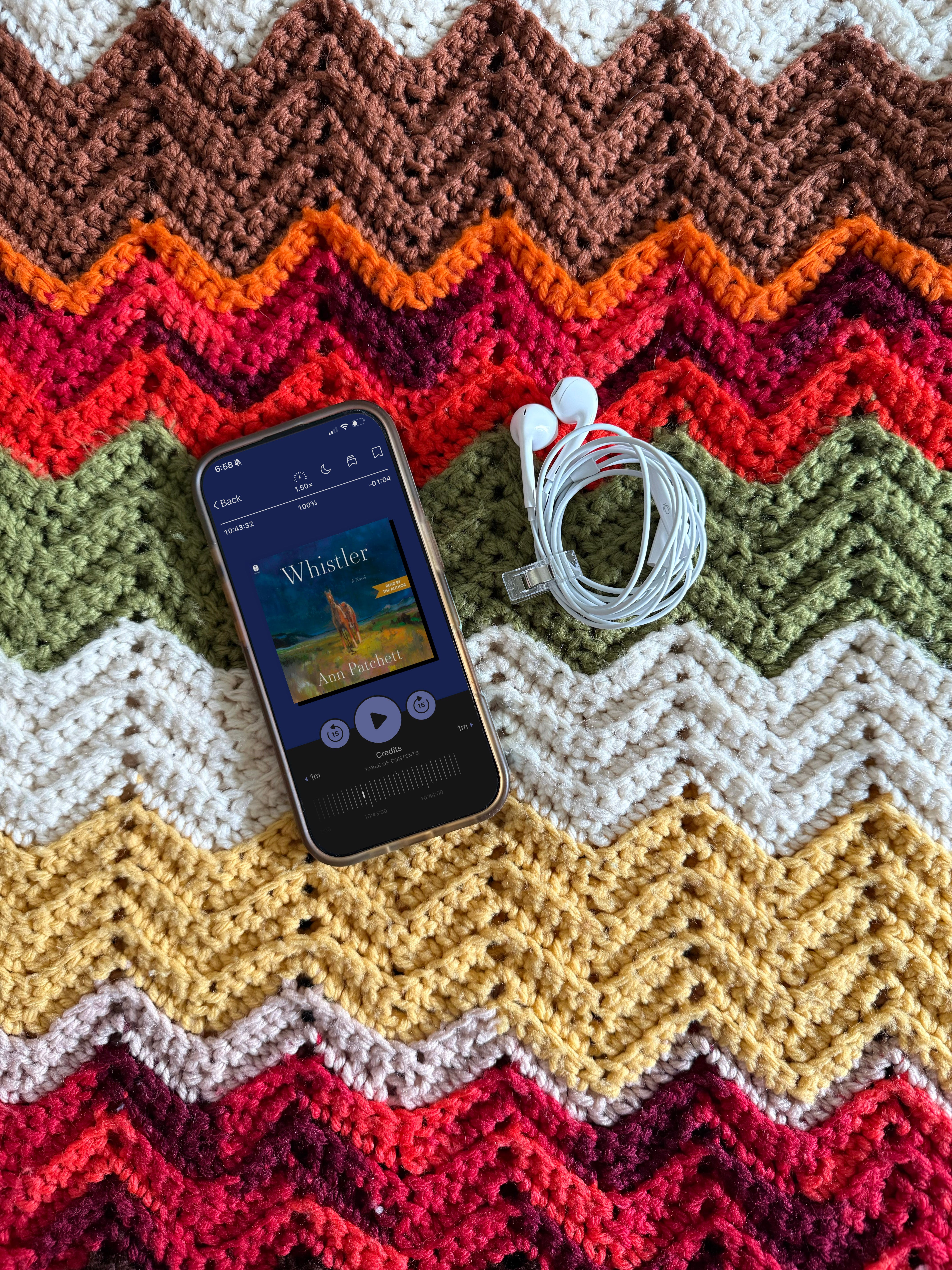
I was folding laundry when Ann Patchett got me, which is the least literary sentence I have ever written and also exactly how it happened.
There is a thread running through Whistler about a house being sold, and about the particular finality of that. Not just leaving a house, but losing your standing to ever walk back into it. You can drive past it, slow down, and know exactly which window is which, but you cannot go in. Whatever happened in those rooms is still in there, and it is in there without you now.
I put the basket down in the middle of the hallway and stood there like an idiot with one sock in my hand.
Here is the thing I should tell you up front. The house I thought of first was not the farmhouse I grew up in. It was the one my kids were little in, the one we moved out of, and that feeling showed up fast and it was plain old missing.
My own childhood house, the farmhouse, arrived about ten minutes behind it, uninvited, and that one had not been missed at all.
I am going to tell you about the farmhouse first anyway, because it turns out it explains the rest.
And the farmhouse is a strange thing to be handed by Patchett’s paragraph, because I can walk back into it. My dad still lives there. I could drive out tomorrow and go in the front door and nobody would stop me, and I could stand in my childhood bedroom if I wanted.
So let me tell you: The house I grew up in was a farmhouse, and it was beautiful, and I was not allowed to have anyone in it.
The rule
My mother had a thing about the farmhouse. I have never landed on the right word for it. Decorator is not right, because that sounds like a job. Collector is closer, because there were antiques, and the antiques had value, and the value was the whole point. But neither really encompasses the entirety.
She was always redoing something, and I want to be precise about what that means, because it was never repair. The farmhouse was old but it was not falling down. We were not patching a roof because water was coming in. We were tearing up perfectly good tile because the hardwoods underneath would look better, painting cupboards to match a photograph in Country Living, and tearing off a side porch we actually used and loved because she had an idea about the landscaping. None of it came from necessity. All of it came from wanting, and from style, and from how a room would look to someone who was not going to be allowed to sit in it anyway.
What that meant, practically, for a kid, was that no other kid ever came over.
I want to be fair, because adults came over, occasionally. My parents had friends, and those friends were in the house sometimes, and that was fine. It was children who could not be in it. Children break things and ruin things, and ruin was her word, and it is not the right word either, because ruin in her vocabulary meant a water ring on a table or a scuff mark on a wall or a spill that came up with a cloth. A thing could be visibly and completely fine and still be ruined.
So I asked constantly, and the answer was always no. I asked for sleepovers the way other kids ask for a dog, with a full campaign and a rotating cast of arguments, and the reason was always some version of a cup. Somebody would set a cup down on the antique trunk we used as a coffee table, or put their feet somewhere, or just exist in the room in a way that left a mark on it.
So I had few friends. That is the part I did not understand until I was much older, because when you are 10 you do not think of it as cause and effect, you just think you are the kind of person who does not have a lot of friends. Friendship at that age is built almost entirely out of proximity and unstructured hours, and unstructured hours happen in houses. If you cannot host, you are outside the loop that everyone else is inside of. You get invited a few times, you never reciprocate, and then you stop getting invited, and nobody is even being mean about it. It is just math.
The house I was jealous of
My best friend lived thirty minutes away. We were both country kids on opposite ends of the same county, which meant every time we saw each other outside of school somebody’s mother spent an hour in a car.
That somebody was always my mother, driving me to her house and back, which she would do cheerfully and repeatedly rather than let my friend come to ours one single time. The math is identical either way. Somebody drives, somebody picks up. She chose the version that kept a child out of her living room.
My friend had six brothers and sisters. Bedrooms were shared. Nothing in that house matched anything else in it, and I have thought about that house more in my adult life than I have thought about almost any other building.
The couch was worn out because people sat on it, together, to watch a movie. You could put your feet on the coffee table. There was a piano and you could play it whenever you felt like playing it, badly, in the middle of the afternoon. You could run up the stairs. Nobody grabbed your arm on the landing to tell you to be careful, because there was no antique hanging in the single dumbest possible place on the wall for you to knock down.
The kitchen was the best part, and the reason is that it was built and organized for using, not for looking at. They canned and cooked and baked constantly, and the counters had stuff on them and the stuff was where it was because that is where a person’s hand goes when a person is actually making something.
They lived in that house. And they let me live in it with them while I was there, which I understood at the time was generosity and did not have the words for.
Lived in. That was the thing I was jealous of, and I did not have that phrase until much later in life either. Not their piano and not their siblings. The wear.
My room, three times
My mom redid my bedroom at least three times while I lived in it, and I was never once asked.
Some summers I went to stay with my grandparents, who I adored, and more than once I came home to a completely different room. Different color, different arrangement, different (new) everything, chosen entirely without me, and then handed to me with a set of instructions. Don’t do that in here, be careful of this, watch out for that.
There was never a place for my boom box or a shelf for my CDs, and I couldn’t do my art because that was too messy and would ruin something. Nothing went on the walls that I picked, because the walls were part of the room and the room was part of the house and the house was for show. And it was for show to an audience that never came, because I still was not allowed to have anyone over.
What the house was actually like
The farmhouse was not a nice place to be, which is the part I skipped over for about thirty years.
My parents fought. Not occasionally, constantly, and at least half of it was about money, which is its own kind of joke in a house where we were demolishing a porch we liked for aesthetic reasons. The only stretches of genuine peace I can remember are the ones where my grandparents came in from out of state, because then the adults seemed to perform and behave. Christmas especially. My grandparents would show up and buy my sister and me the gifts my parents could not afford, and for a few days the house would go quiet and warm and my parents would act like people who liked each other.
So the antiques were being protected inside a house that was not, by any other measure, being taken care of.
The purple
My parents finally divorced when I was a senior in high school. My dad’s girlfriend moved in the day my mom moved out, which, after some therapy, is a sentence I can now say in a normal voice. I did not go anywhere until college. I floated between the two of them, my Mom and Dad’s, a night here, a week there, wherever I felt like being.
Two things happened that summer, about a month apart, and I have never been able to think about one without the other.
My mom had moved into a different house. New to her, not new by any stretch of the word. And when I asked about my room there, she told me I would be sleeping on a mattress on the floor, and that I was not to decorate it, not to hang anything, not to make it mine in any way, because I was leaving for college in a few months and she had plans for the room.
I understood that sentence perfectly at seventeen. The room was going to be nice. It was going to be nice after I was gone. But would it be for me when I came home from college? I knew that answer was no.
And then my dad’s girlfriend told me I could paint my bedroom at the farmhouse any color I wanted.
I think she meant it kindly. I’d like to think it’s so I would know I had a space to come back to during my college breaks. A space that would always be mine. I think she was trying to be a friend to me, or a decent stepmother, or both, and she reached for the one thing she had to give. I do not think she had any idea what she had just done.
I picked the brightest purple in the store. Not lavender, and not a nice grown-up plum, but a purple that a paint company invented in a fit of optimism and probably regrets. It was, objectively, a terrible choice. I painted every wall.
Because here is what had never happened in that house: I had never picked anything. Not the color, not the furniture, not where the bed went. My room got redone the way the rest of the house got redone, on somebody else’s schedule, to somebody else’s taste, and I lived in it the way you live in a hotel. So when I finally got a vote, I did not cast a reasonable one. I cast the loudest one available.
I have thought about that day a lot since, and I have never once been embarrassed about the color. It was one of the best days of my life. I got to make the room mine for four weeks, and four weeks was enough. I even got to hang my artwork on the walls which I can’t even explain how that made me feel.
That room is red now. My step brother had the room after I left and it has been red for a long time. I could go stand in it this weekend if I wanted to. My dad would put coffee on.
I do not particularly want to.
What I carried out of it
Here is the part I actually did not expect Whistler to hand me.
When my husband and I bought our first house I furnished it beautifully, immediately, on purpose, and I knew there were going to be kids in it soon. I did it anyway. I bought the nice version of everything, and I did not experience it as a decision, because it was not one. That was what a house was. You made it pleasing and made it look like something. It was the assignment, and I had been handed it so early that I did not know a different assignment existed.
Nobody ever told me the other thing, which is that you are supposed to be building a home, and that a home and a house are not the same object and are sometimes in direct competition with each other.
And I have said my mom’s exact sentences that traumatized me so much. Out loud. In my own house, to my own kids, in her exact cadence, about a cup on a table. I hear it leave my mouth and I want to reach out and grab it back. You do not get to grab it back.
The thing is, I was never actually upset about the cup or the spill.
That is what I have only recently worked out. One of my kids would knock something over and I would feel nothing in particular about it, because it is a spill, and it comes up with a cloth, and cleaning it takes ninety seconds and I do not mind cleaning. Left to myself I would have laughed about it with my kid, and we would have gotten a towel, and it would have been a small funny thing that happened on a Tuesday.
But I thought I was supposed to be mad. I had been trained that a spill is an event, that somebody is supposed to react, and so I performed a reaction I did not feel, at a child, over something I genuinely did not care about. And in doing that I took a moment that was going to be fine and made it into a moment about being careful. However many times I did that, I passed the whole thing down another generation, and one of my kids is going to stand in their own kitchen someday feeling a false flare of anger about a countertop and not know where it came from.
And I keep doing this math I hate. All the money that went into nice things, into the good version of a room, during the years there were small kids in it. Every one of those things could have been secondhand. Every single one. Get the beat-up thing, let it get more beat up, let it be a house where people come in and put a cup down, and then when everyone is grown and gone, then go buy the nice table. Nobody would have known or cared, and the house would have been so much happier.
A house that gets lived in is what a happy house looks like. The wear is not the damage. It is the evidence.
The part I am still in the middle of
There is a worse version of this, and I am still inside it.
I redecorate when I am sad.
I did not see the pattern until the last few years, which is a humbling thing to admit to strangers. A kid leaves for college and the quiet is unbearable, and within a week I am repainting an entire level, buying pillow covers, hanging different art. I am not tearing up flooring and I am not adding rooms, so for a long time I told myself it was not the same thing. It is the same thing. It is a smaller version of the identical instinct, which is to answer a feeling by rearranging a building.
I can count it, which is the embarrassing part. Some rooms in our current house have changed their whole look five or six times in ten years. I have put wallpaper up and taken it down a few years later, and I have painted a room a color I was sure about, decided I did not like it and painted it right back to the safe gray it started as.
And I know the difference, because I have done the other kind. We once bought a house in a college town to run as an Airbnb, and it needed real work before anyone could stay in it. That renovation had a reason and a finish line. The wallpaper did not. Renovating because a house needs it is one thing, and renovating because I am sad or bored is something else entirely.
It does not work, and it never has. I finish the room and the kid is still gone and now I have also spent money, so I get to feel the original thing plus a new layer of being annoyed at myself for not noticing sooner.
We want a lake house someday. That is the semi-retirement plan, the actual one, and every one of those sad-week paint projects is money that was not going toward it. I am not worried about the spending itself anymore. I am worried about the pattern I inherited without ever agreeing to it, and whether I can put it down before it costs me the one house I actually want.
And I wonder about this every time I open Instagram, honestly. A whole industry of people redoing their homes on camera. New rooms constantly. And I find myself wanting to ask a rude question, which is whether anybody lives in there, whether the couch is comfortable, whether a kid has ever put a cup down on that table without somebody flinching, or whether it is a set, being redone for views and sponsorships, the same way my mother’s house was being redone for an audience that never came.
I do not actually know. I just recognize the shape of it.
I want to be clear about that, though. I am not knocking anyone who loves decorating or a good renovation. Wanting a house that is nice and feels like you is a completely normal thing to want, and plenty of people redo a room because it makes them happy and it actually does. I am not writing about them. I am writing about me, and about how much money I have spent on rooms I was sure would make me feel better.
The second house
There is another house, and this one was ours, and it is the one that actually gets me. It is also, as I said at the top, the one I thought of first. Everything else in this essay came in behind it.
My family of five moved when my kids were in junior high and elementary school. It was a good move for the right reasons, and I don’t regret it. But I want to go back to the old one so badly sometimes that it is almost physical. Not to live there, just to walk through it.
There was a tree in the backyard that was theirs, in the way a tree becomes a specific tree. The front yard was where the sprinkler went in July and the sled came out in January, and I could not tell you a single individual day of either one, which I think is the point.
We moved bedrooms around when our surprise third arrived. My daughter was thrilled it was a boy, and not for any of the reasons you would expect. It meant the boys went upstairs and she got the downstairs room to herself, and it meant she got to pick. The paint color, the bedspread and the curtains were all hers.
I got to stand there and watch a kid choose her own walls. Nobody ever handed me that, and I did not know until it was happening how much I wanted to see it.
I want to stand in the room where they were babies and see how big it actually is, because I have a feeling my memory has the dimensions wrong.
You do not realize how much a house is holding until you do not have access to it anymore. It is not that the memories are gone. It is that they were partly stored in the building, in the specific way the light came through one window in the afternoon, in the sound a particular door made, and I did not know I had outsourced that much of it. I thought I was keeping all of it in my head. I was keeping about sixty percent of it in my head and the rest of it in the drywall.
Somebody lives there now and their kids are the ones who know what that door sounds like.
That is the house Patchett was talking about. Not the farmhouse. I can walk into the farmhouse whenever I want and it turns out that was never what I was missing.
What Whistler actually did
None of this is what Whistler is about, exactly. It is a novel about a woman and the stepfather she lost for forty-five years and got back for a minute, and about a story he told her once in an overturned car in the snow, and about a horse. It is about impermanence in the largest possible sense, and it is generous and calm about it in a way I was not prepared for.
But there is that one thread about the house, and about the door closing on a place you used to be allowed inside of, and Patchett does not overwork it. She just puts it down and leaves it there, and that is the whole trick: she lets you be the one who supplies the farmhouse.
I listened to this on audio, and she narrates it herself, and I want to be careful about how much I gush here, because “read by the author” is usually a warning label. This is not that. She reads it like someone telling you something true across a kitchen table, and there are places where she gets quieter instead of louder, which is a choice almost nobody makes.
Format: Audiobook (narrated by Ann Patchett) | Source: Library | Rating: 5 stars
The structure is two timelines, present-day New York and one night in 1980, and they braid tighter as you go until the seam disappears. It is short, 304 pages, and it does not feel short. My one honest critique is that the ending refuses to resolve on purpose, and if you are a reader who needs the door closed at the end, this will bother you. It did not bother me. It felt like the only ending that matched the argument the book had been making the whole time, which is that connection is the thing, and closure is a story we tell about connection after the fact.
Where this one is sending me next: Horse by Geraldine Brooks, which I have not started yet, and more Ann Patchett, because I am nowhere near done with her. Whistler also left me with a question about the difference between a house and a home, and I have not found another book that picks that up. If you know it, tell me.
Where else Whistler has shown up:
August: I Was Wrong Twice, 7 Books, $0 Spent, and My First Reading Tree Miss (where I first ranked it)
Grab a copy of Whistler. Library first, always. But if you are buying anyway, my Bookshop.org links back indie bookstores and a sliver comes to me. No pressure.
One question
I want to know about your house. Not the one you live in. The one you would walk through if somebody handed you a key and thirty seconds and no explanation.
Which room would you go to first?
If this one stayed with you, these two are close cousins. One is about the house going quiet before any of my kids actually left, and the other is about the season of my life I would step back into if I could.
The Table Got Quiet Before Any of My Kids Moved Out

A dinner scene in The Latecomer made me cry in my car because I’ve already lived it.
The Bookmark I’d Put in My Own Life

A library where time stops made me ask which season of my life I’d step out of. I don’t want to skip it, I want a redo.