


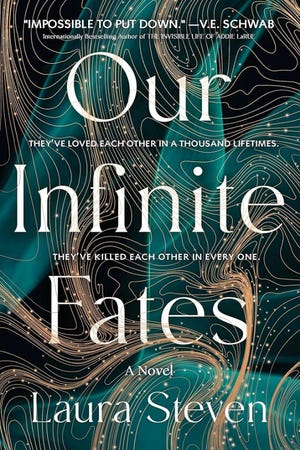
I just finished Our Infinite Fates by Laura Steven, and I can't stop thinking about one detail the book treats as almost ordinary: in each lifetime, the two main characters come back in different bodies. Sometimes male and sometimes female, with different sexualities and different circumstances every time. The love persists regardless.
The book doesn’t pause for a lesson. It just lets it be true. And that quiet certainty is what makes it so powerful.
I would not have found this one on my own. It came to me the way most of my books do now, by being the next thing after something else. I loved The Invisible Life of Addie LaRue, this was pitched straight at people who loved Addie LaRue, and that is the only reason it ended up on my Kindle. One book handing me the next.
The map so far: The Invisible Life of Addie LaRue → Our Infinite Fates → This Is How You Lose the Time War, which I am currently reading.
This book sent my brain somewhere the author maybe didn’t intend.
The soulmate question we don’t ask
We love the idea of soulmates. Someone out there for you, connected across time and space. But here’s the question we skip: if soulmates are real and come back in different bodies, what happens when yours shows up in a body you’re not attracted to?
Say you’re a straight woman in this life. Your soulmate has been your partner across 50 lifetimes. This time, they come back as a woman. Do you recognize them? Does the soul connection override the body?
Our Infinite Fates creates a world where the answer is obvious: love doesn’t care about the container. The soul is what connects. Everything else is just the outfit it’s wearing this time.
That’s a beautiful idea. It’s also an uncomfortable one, and I think that discomfort is worth sitting with.
What it means for how we think about love
If love transcends gender and physical form, the categories we build around attraction start to look less like hard rules and more like current settings on a dial that keeps turning. You’re a soul that’s been everything, attracted to another soul that’s been everything. This lifetime you happen to be in this particular body with this particular orientation.
I’m not saying that’s how it works. I’m saying that’s the thought experiment this book creates, and it’s one of the most interesting things I’ve sat with in a while.
The souls that find their way back
There’s a passage in the book that stopped me: “Lost souls were drawn to the love still felt for them by the living. This meant that parents were often reborn as their children’s own children, and siblings who died together were reborn as twins, and various other dynamics that I’d found troubling and yet strangely resonant.”
Troubling and yet strangely resonant. That's exactly right. The idea that love is a kind of gravity, that the people who loved you hardest pull you back, is one of those ideas that sounds impossible and feels true at the same time. And the implications are wild: your child might be your mother, come back to you. Your twin might be the sibling you lost in another life.
It’s the kind of thought that makes you look at the people around you differently.
The notebook
“Whatever a soul was, it could be carried in a notebook.”
This one line carries the whole book. The poetry book at the center of the story is the proof that love leaves evidence, not in grand gestures or monuments but in words, in a notebook. It was written across lifetimes, carried from life to life, and nobody knows whose hand started it.
It makes you wonder how many remarkable books in our world’s history could have been written from exactly that kind of love and pain. Written by someone who remembered too much.
The families
In each lifetime, these characters are born as babies. To new parents. With new siblings. People who love them and will grieve them when they die before 18. Evelyn remembers all of it.
Imagine having 20 different mothers and carrying the love and loss of every single one.
As a mom of three, that detail destroyed me. My child could be living their 20th life and remember 19 other mothers before me. Devastating. But it also means the love doesn’t disappear. It accumulates.
Big joy and small joy
There’s a passage where a character says something I can’t stop thinking about: “I think I understood a long time ago that big joy and small joy are the same. It sounds trite, but it’s true.” He describes winning a major tennis tournament and bringing home a huge cash prize, and says that victory felt no different from curling up in an old armchair with a faded blanket and reading his little sister a bedtime story. No different from a perfect pot of coffee or a warm croissant fresh from the bakery.
And then: “Even when there’s no big joy, even when it feels like we’ll never leave this trench alive, there’s still the small joy. A sunset, a flask of tea. Your hand in mine.”
The older I get, the more I agree with this. The big wins feel great in the moment, but the feeling fades to the same warmth as a quiet morning with good coffee. And the small joys, when you really notice them, feel exactly as big as the trophies. Maybe that’s the whole point. Maybe when you’ve lived enough lives (or just enough years), you stop ranking joy and start collecting it.
Why evil can’t win
There’s a thread about evil trying to recruit and win by numbers. It never works. Love, even outnumbered, is stronger. Not magic. Just what it makes people capable of.
Don’t follow bad. Love more. That’s it.
Our Infinite Fates. Five stars. Read it especially if you think you know what love looks like.
Where this one is sending me next: enough people told me that if I loved Addie LaRue and I loved this, then This Is How You Lose the Time War was the next stop. I'm reading it now. I'll tell you whether they were right.
Get your own copy of Our Infinite Fates here. My Bookshop.org link supports indie bookstores and tosses a few cents my way.
This book sounds right up my alley. I also loved Addie LaRue. And while I have no idea if soulmates across space and time are real, it is something that feels real. Or real enough that, like you did, I want to sit with it awhile. So glad you shared this one.