


I DNF’d Flights by Olga Tokarczuk. I’ll be upfront about that. The fragmented, philosophical style wasn’t for me, and I fast-forwarded through chunks of the audiobook trying to find something to grab onto. I never did.
But one small detail from the book has been living in my head ever since.
There’s a traveler in one of the stories who only buys paperback books. Not because of weight or cost or preference. Because when she finishes them, she leaves them on benches at train platforms for the next person to find.
That’s it. That’s the whole thing. And it wrecked me in a way the rest of the book couldn’t.
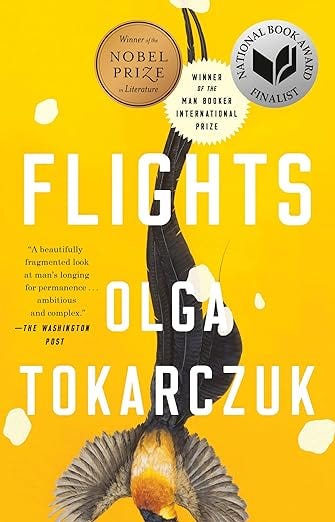
Why a book on a bench matters
Think about the life of that paperback.
Someone wrote it. Someone printed it. Someone put it on a shelf in a bookstore. Someone bought it, read it, maybe loved it, maybe didn’t. It ended up in a donation bin or a thrift store or a box in someone’s garage. Then this woman picks it up, reads it on a train, and sets it down on a bench for a complete stranger. She walks away. She doesn’t know who will pick it up. She doesn’t care if they love it or hate it or leave it there for the next person. She just trusts that someone will find it when they need it.
That book has lived more lives than most people I know.
And that’s what I keep coming back to. Books aren’t objects. They’re travelers. They pass through hands and lives and they carry a little bit of every person who held them. The dog-eared pages someone left behind. The cracked spine from being read in one sitting. The coffee ring on the cover. Those aren’t damage. Those are proof of life.
Sometimes the traces a reader leaves are even more personal than that. Someone underlines the line that gutted them, and years later you find yourself stopping cold on the exact same sentence. Someone fills the margins with notes, a question mark here, a little “yes” scrawled next to a paragraph, a quiet argument with the author that nobody else will ever see. Some people even write their name and the date they finished it inside the cover, so the book carries a record of everyone who has ever lived in it. When you open a copy like that, you’re not just reading the story anymore. You’re reading everyone who read it before you.
The Shelfless Reader builds a shelf
If you read my first post on here, you know the deal. I read over a hundred books a year. I don’t own a bookshelf. Almost everything I read is on Kindle or audiobook, and I’ve never felt like I was missing anything.
But I also told you I was thinking about making one exception. A small shelf. Not a library, not a wall. Just my all-time favorites, the six-star reads, the ones I want to be able to physically hand to someone.
I’ve started building it. Slowly. I thrift my five-star reads when I can find them, buying used copies at Goodwill or secondhand shops whenever I spot one. I find maybe one every three trips. It’s slow going, and that’s part of what makes it special. Every book on that future shelf will have been hunted for, not ordered.
The copy I’m secretly hoping to stumble on is one that somebody else already made their own. Underlined passages, thoughts pencilled into the margins, a name and a date written on the first page. There’s something about holding a book like that, knowing a stranger sat with the same words and left their fingerprints all over them, that feels like connecting with another reader I’ll never meet. I’d get to see the whole life the book lived before it reached me, which lines stopped someone else cold and which ones they argued with. Give me a marked-up, dog-eared copy over a pristine one any day.
I recently found The Women by Kristin Hannah at my favorite thrift store. I was browsing the book section and the worker had her restocking cart out. I spotted it on the cart before it even hit the shelf and asked if I could grab it. Hardcover, near-perfect condition, three dollars. The old lady pushing the cart just gave me this smile. Not a customer service smile. A reader’s smile. The kind that says “I know exactly why you just grabbed that.” And as I walked through the store with it in my cart, I caught more than a few glances from other shoppers who saw what I had and knew they’d missed it.
But it was meant for me. That’s how I felt about it. That copy had a life before me and it found its way to my cart at the exact right moment.
The old book lady I want to become
I have this vision of myself in thirty years. Gray hair, probably with some color in it. Cool glasses. The kind of style that makes people look twice. And I’m walking down a street having just finished a paperback, and I see someone sitting on a bench or waiting for a bus, and I just hand it to them.
“Here. I just finished this. I think you might need it.”
Maybe they read it. Maybe they don’t. Maybe they pass it on to someone else. But that book keeps moving. It went from a thrift store with a full life already behind it, to me, to a stranger, and on and on through its own journey. Just like us. We pass through each other’s lives and leave something behind, whether we know it or not.
I’ve actually been thinking about getting book stamps made. The kind you press into the front page that says something like “This book is meant to be passed on. When you’re done, give it to someone who needs it.” A little nudge to keep the journey going. Because a book sitting on a shelf you’ve already read isn’t doing its full job. A book in someone’s hands? That’s a book at work.
Books find you when you need them
I don’t think I’ve ever picked a book up off a bench from a stranger. Nothing that cinematic. But I do believe that books find you when you need them, even if the way they arrive is completely unglamorous.
Far from the Tree found me because it had no wait on Libby and Julia Whelan narrated it. That’s it. No grand recommendation, no algorithm, no curated list. Just availability and a narrator I trust. And it gave me a metaphor about training wheels that I’m still thinking about weeks later.
The Latecomer cracked open fears about my kids that I’d been carrying for years but never had the words for. I picked it up for the same boring reason: Julia Whelan, no wait.
Kristin Hannah found me because The Great Alone popped up at the right time, and within six weeks I’d torn through three of her books and discovered that historical fiction was the genre I’d been looking for my entire reading life without knowing it. ACOTAR proved I could love fantasy when I’d sworn I never would. The Tattooist of Auschwitz taught me more about WWII than school ever did and opened a door to an entire world of historical fiction I haven’t stopped walking through.
None of these were planned. None of them came from a bestseller list or a bookstagram recommendation. They just showed up. And every single one of them sent me somewhere I didn’t expect, whether that was down a Google rabbit hole at midnight, into a new genre, or straight into my own feelings about something I’d been avoiding.
That’s what I write about here. The rabbit holes, the reading trees that connect one book to the next, the moments where fiction cracks open something real. Every series on this Substack exists because a book found me and did something I wasn’t expecting.
The woman on the bench knew something
The woman in Flights who leaves paperbacks on train benches understood something simple: a book’s job isn’t finished when you close it. It’s finished when it runs out of people to reach.
I didn’t love Flights. I probably won’t ever recommend it. But that one image changed how I think about every book I touch. The thrifted copy of The Women in my cart wasn’t just a three-dollar find. It was a book in the middle of its life, passing through my hands on the way to whoever comes next. Maybe my daughter. Maybe a friend who’s never been a reader and needs the right book to start. Maybe, someday, a stranger on a bench.
I’m building a shelf, but I’m not building a museum. I’m building a lending library. A rest stop for books that are just passing through on their way to the next person who needs them.
The Shelfless Reader is getting a little less shelfless. And I think that’s exactly right.
Grab a copy of Flights. (I didn’t love it, but that one detail might be worth the trip.) My Bookshop.org link supports indie bookstores and tosses a few cents my way.
I love the idea of a book being a traveler and living more lives than people realize. When I think about all of the physical library books I’ve borrowed over the years, the concept fascinates me even more. Finding that copy of The Woman was incredibly lucky too. I’m glad it found you at just the right time!