


I gave Cleopatra by Saara El-Arifi four stars and five Google searches. That ratio tells you something about this book: it is deeply researched, beautifully written, and full of details that sent me straight to my phone mid-chapter.
El-Arifi writes Cleopatra’s story as though someone who actually knew her was finally allowed to speak, and not the Roman version or the Hollywood version but the one where she is a mother and a ruler and a sister and a strategist, all at once, all the time. The footnotes throughout the book, where El-Arifi flags which pieces of history were probably exaggerated and then lets Cleopatra correct the record inside the narrative, made me question everything I thought I knew.
Here are the five things I Googled.
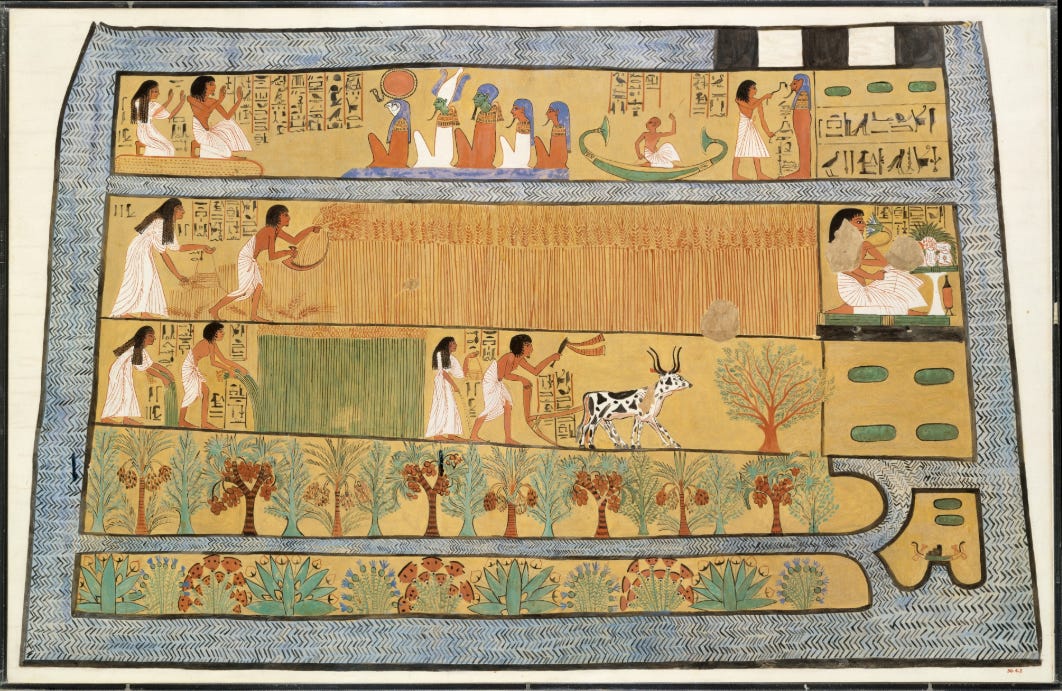
Sennedjem and his wife harvesting grain in the Field of Reeds, a facsimile of a painting from his tomb at Deir el-Medina (original c. 1295 to 1213 BC). The Egyptian year, Shemu included, was built around the harvest. Image: The Metropolitan Museum of Art, public domain.
What is Shemu?
The book references Shemu frequently, and I had no idea what it was. Turns out, Shemu was the third season in the ancient Egyptian calendar: the harvest season. It ran from roughly May to September, during the period when the Nile was at its lowest before the annual flood.
Ancient Egypt did not use a four-season calendar the way we do. They had three seasons, all tied to the Nile: Akhet (the flooding), Peret (the growing/emergence), and Shemu (the harvest). Their entire agricultural cycle, and by extension their entire economy, revolved around the river. Shemu was when farmers harvested emmer wheat, barley, flax, and vegetables from the nutrient-rich soil the floods had deposited months earlier.
What struck me is how different this is from the planting-and-harvesting cycle I grew up understanding. In Egypt, you planted after the floods receded and harvested in what we would think of as late spring and summer. The Nile dictated everything.
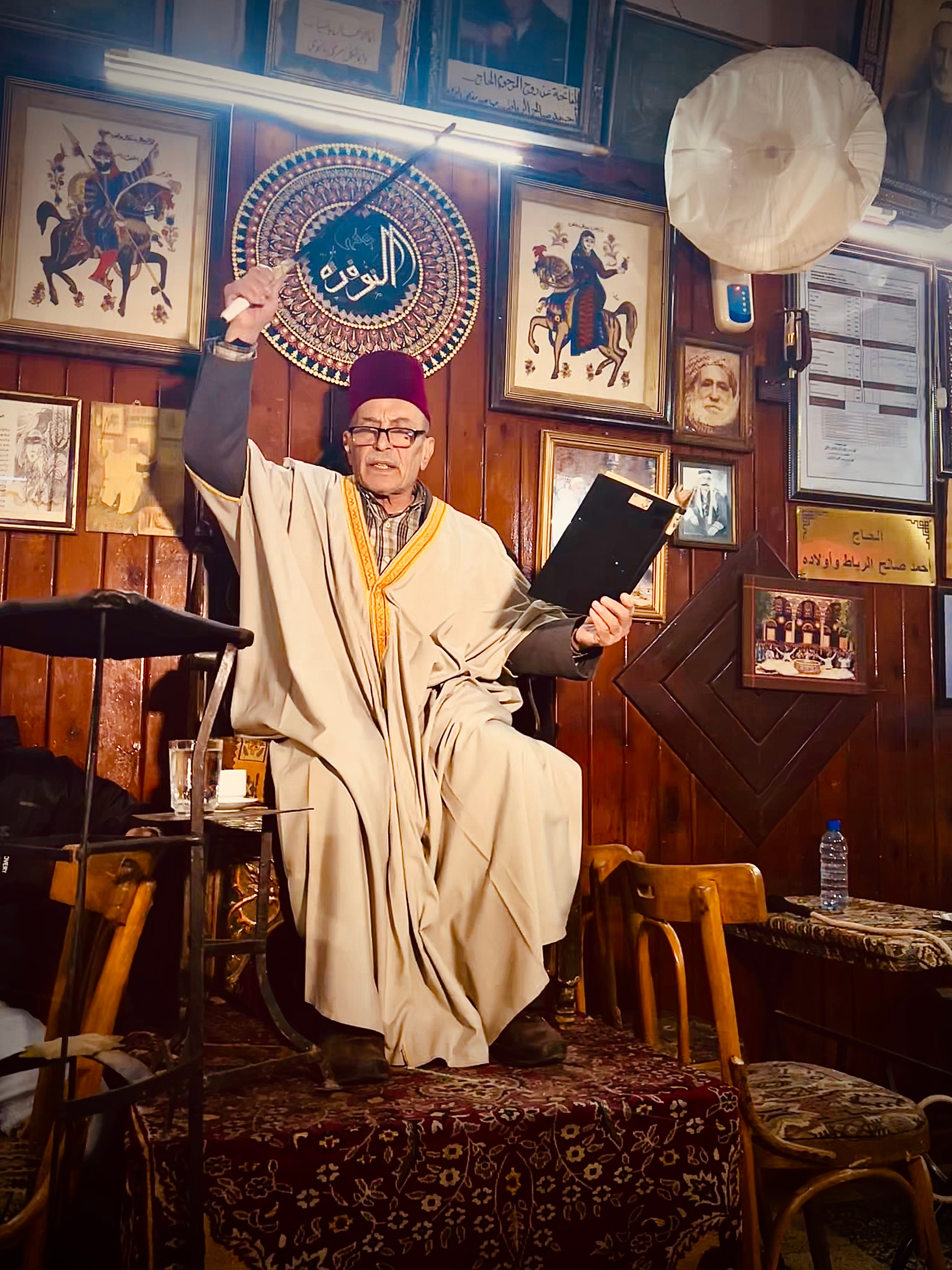
A hakawati in an old Damascus cafe, keeping the centuries-old storytelling tradition alive on the nights of Ramadan. Photo: [photographer] via Wikimedia Commons.
What is a Hakawati?
This word appears in the book and I had to look it up. A Hakawati is an Arabic storyteller. The word comes from a fusion of two Arabic words: hekaye, meaning “the story,” and haki, meaning “to talk.”
For generations, the Hakawati was a central figure in Arabic culture. People would gather in coffeehouses, homes, or outdoor spaces, and the Hakawati would narrate stories of heroism, romance, tragedy, and comedy. These storytellers represented the collective memory and imagination of their communities. They brought historical figures to life, spun tales from the Quran, and breathed humanity into legends.
The tradition has faded with modernity, though there has been a revival in recent years. Reading about it in the context of Cleopatra’s story felt fitting. El-Arifi is doing something similar: taking a story that has been told a thousand ways by a thousand people and giving it back its original voice.
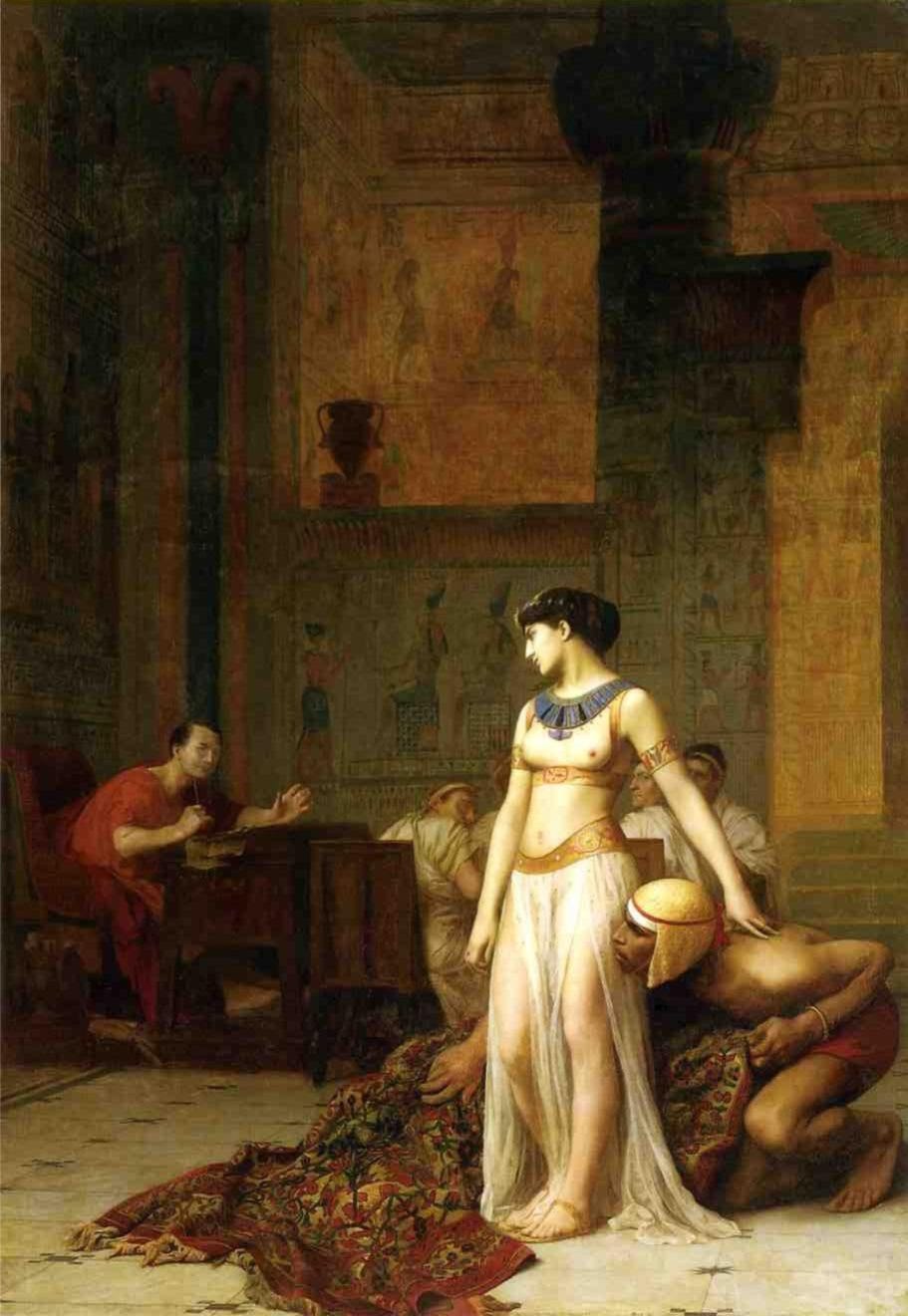
Cleopatra and Caesar (1866) by Jean-Léon Gérôme, one of the earliest paintings to show her emerging from the carpet. The "carpet" detail itself traces back to an 18th-century translation of Plutarch more than to history. Image: public domain, via Wikimedia Commons.
Was Cleopatra actually Caesar’s lover?
The book portrays a romantic relationship between Cleopatra and Julius Caesar, and I wanted to know how much of that was historically supported.
The answer: quite a lot. Cleopatra and Caesar’s relationship began around 48 BC, when he was 52 and she was 21. Caesar had pursued Pompey to Egypt during the Roman Civil War, and Cleopatra, locked in her own power struggle against her brother Ptolemy XIII, saw an opportunity. She famously had herself smuggled into Caesar’s presence, rolled in a carpet (or possibly a linen sack, depending on the source).
In 47 BC, Cleopatra gave birth to Ptolemy XV, known as Caesarion, whom she claimed was Caesar’s son. Caesar never formally acknowledged him as his heir, but in 46 BC, Cleopatra and their son visited Rome and stayed at one of Caesar’s estates.
The relationship was both political and personal, and it lasted until Caesar’s assassination in 44 BC. What El-Arifi does with this in the novel is make it feel like more than a political alliance without losing the political dimension.
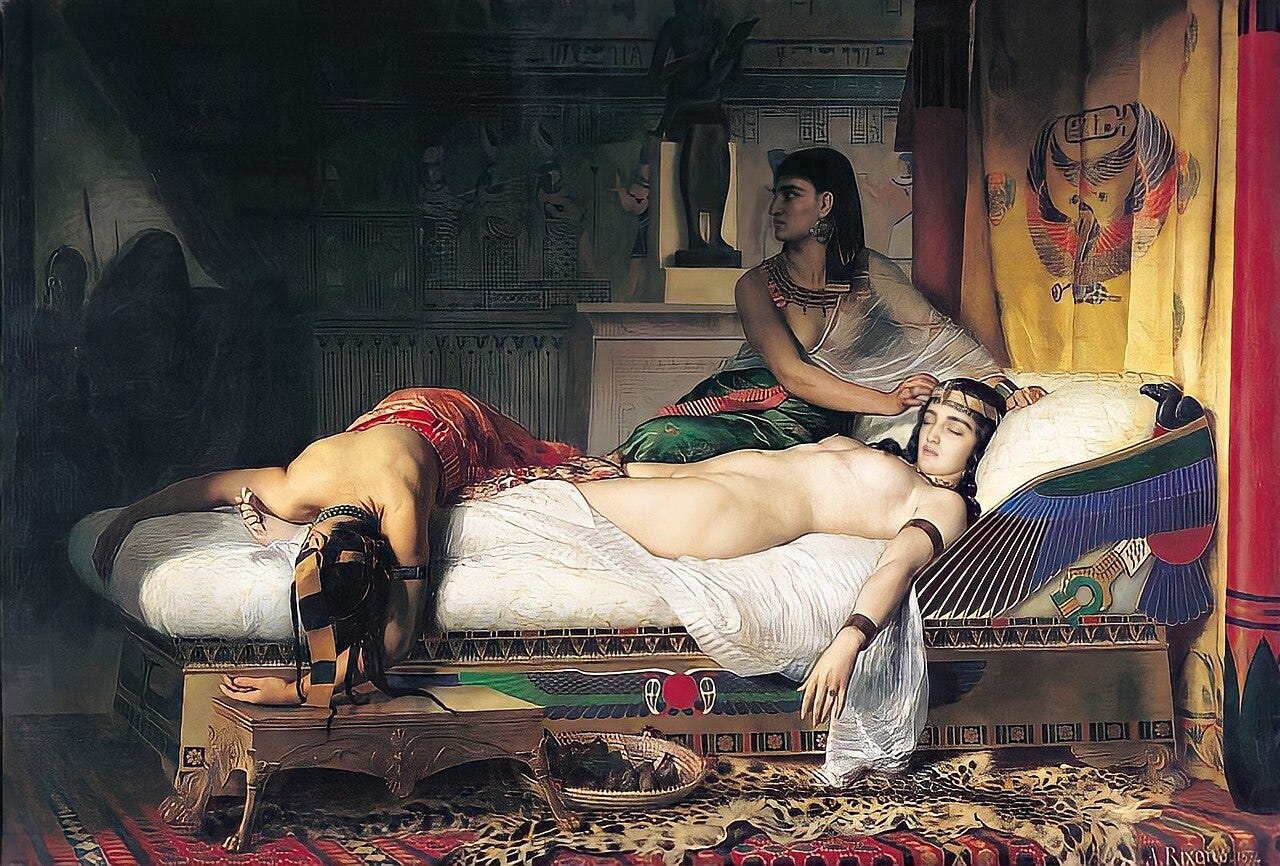
The Death of Cleopatra (1874) by Jean-André Rixens
The painting of Cleopatra and the cobra
The book references a famous artistic depiction of Cleopatra’s death, and I went looking for it. What I found was not one painting but an entire genre.
“Cleopatra with the Asp” has been painted by dozens of artists across centuries. Guido Reni painted a version in the 1620s showing Cleopatra pressing the snake to her breast. Jean-André Rixens painted a lavish version in 1874. Guercino, Michel Corneille, and countless others took on the subject.
The traditional story is that Cleopatra killed herself by allowing an asp to bite her rather than be paraded through Rome by Octavian. But here is where El-Arifi’s footnotes become so valuable: the historical evidence for this specific method of death is thin. It is one of those details that became “fact” through repetition, not through proof.
What fascinated me most is how these paintings, created centuries after her death, shaped the popular image of Cleopatra far more than any historical source did.
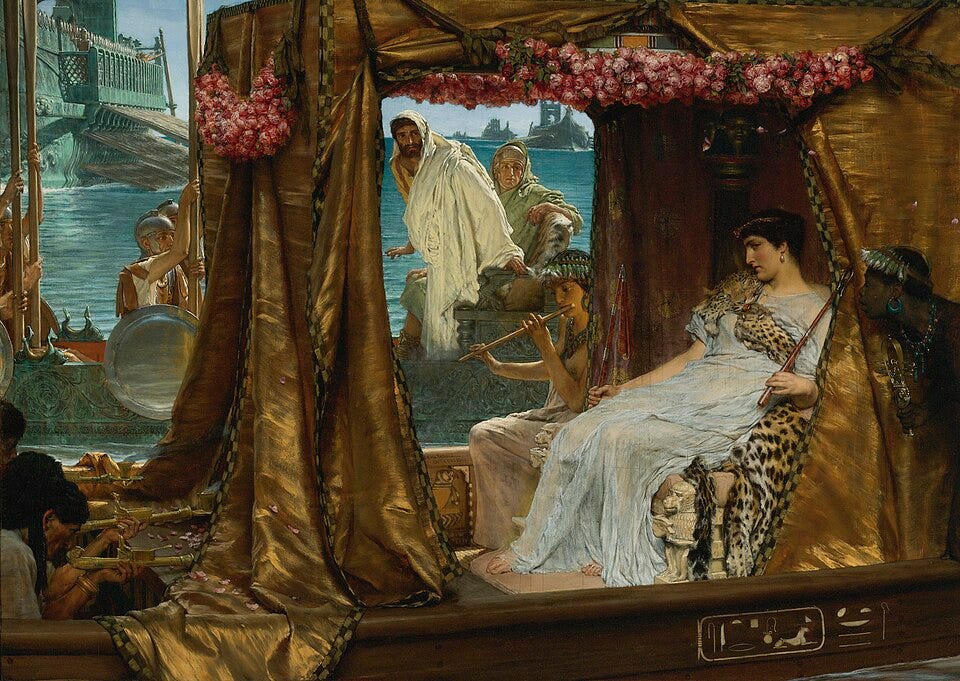
The Meeting of Antony and Cleopatra, 41 B.C. (1885) by Sir Lawrence Alma-Tadema.
Cleopatra’s barge
The book also references Cleopatra on a ship, and I Googled the classical paintings of this scene. The most notable are “The Triumph of Cleopatra” (first exhibited 1821, now in the Lady Lever Art Gallery) and “Cleopatra’s Barge” by Frederick Arthur Bridgman.
These paintings illustrate one of the most famous scenes in ancient history: Cleopatra sailing to Tarsus to meet Mark Antony. According to Plutarch, her barge had purple sails, silver oars, and was perfumed so heavily that people on shore could smell it before they could see it. She arrived dressed as the goddess Aphrodite.
Whether or not Plutarch’s account is accurate (and El-Arifi has thoughts about that), the image has persisted for two thousand years. It is another example of how the art and literature about Cleopatra have overshadowed the historical reality, which is exactly the tension El-Arifi explores throughout the entire novel.
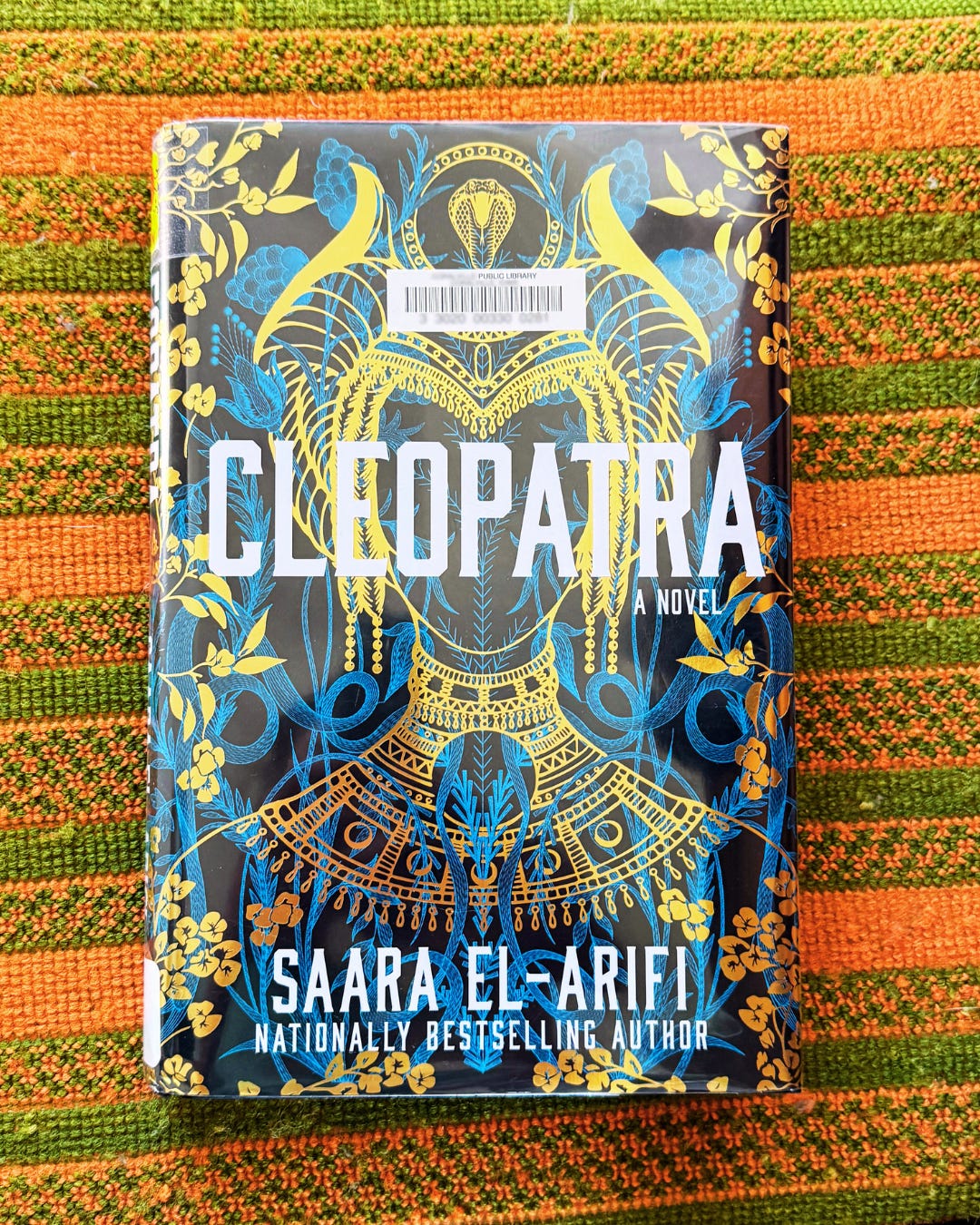
The review
Format: Physical | Source: Library | Rating: 4 stars
If you like your historical fiction anchored in real research, this belongs on the shelf with Kate Quinn’s Mistress of Rome and Costanza Casati’s Clytemnestra, the strong-women-of-the-ancient-world group. The love story threaded through it kept the politics from ever reading like a lecture. The only reason it’s four stars and not five is honest and a little hard to explain: I loved it the whole time I was in it, but it didn’t stay with me in the days after the way my five-star books usually do. Still, very few novels have ever sent me to my phone five separate times, and that alone tells you how alive it felt.
Grab a copy of Cleopatra.
Get it from the library if you can. If not, Bookshop.org over Amazon, always.
Now I want to hear from you, and the comment button is right there for it: what's a "fact" from history you believed for years before finding out it was mostly myth, the thing everyone repeats that turns out to be thin on proof? Tell me in the comments.
This is the kind of review I love! I also really enjoyed this book, though I chose to listen because I loved the narrator, but apparently missed these footnotes! 🤯