


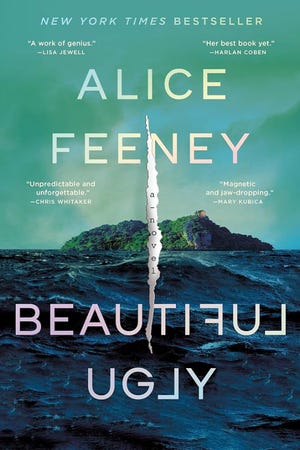
This book didn’t wreck me emotionally or make me rethink my life, but it did something almost as dangerous: it made me curious.
Here’s where my brain went.
1. Do authors actually steal other authors’ work?
There’s a plot point in this book (mild spoiler, but it’s hard to talk about my rabbit holes without it) where a character passes off someone else’s writing as their own. My first thought was: does this actually happen?
Turns out, yes. More than you’d think.
The most famous recent case is probably Cristiane Serruya, a romance author who was caught in 2019 plagiarizing from dozens of other writers. We're not talking about borrowing themes or being 'inspired by.' She was lifting entire passages. Nora Roberts was one of the authors she copied from, and Roberts did not let it slide quietly.
Then there’s Q.R. Markham (a pen name), whose 2011 spy novel Assassin of Secrets turned out to be a patchwork quilt of stolen passages from James Bond novels, John le Carre, and others. The book was pulled from shelves within days of publication. He’d literally stitched together sentences from other people’s books and called it his own.
The more I dug, the more cases I found. Some were clear-cut theft. Others lived in that gray area where “influence” and “borrowing” start to blur. Which brought me to my next search...
2. Are authors using AI to write their books?
This one spiraled. I started Googling whether AI ghostwriting is becoming a thing in publishing, and the answer is: it already is, and it’s messy.
Amazon had to cap the number of self-published books an author could upload per day because people were using ChatGPT to churn out entire novels and flooding Kindle Unlimited. Some authors reported finding AI-generated books published under names suspiciously similar to theirs, clearly designed to siphon off sales.
Then there’s the philosophical question that I couldn’t stop turning over: if there are only so many stories to tell, and AI is trained on all of them, does “original” even mean anything anymore? I don’t have an answer. But the question felt different after reading a book where a character literally steals someone else’s words to try to salvage a dwindling career. Feeney probably didn’t write this as a commentary on AI in publishing, but the timing made it hit that way.
3. Is the island in the book a real place?
The island in Beautiful Ugly is described as this remote, windswept Scottish island you can only reach by ferry. Standing stones. Dramatic cliffs. The kind of place that feels ancient and alive. I needed to know if it was real.
The short answer: it’s fictional, but it’s clearly inspired by real Scottish islands. The descriptions remind me most of the Outer Hebrides, particularly Lewis and Harris, which is home to the Callanish Standing Stones -- a stone circle that predates Stonehenge. You can only get there by ferry from Ullapool or by a small plane, and the landscape is exactly the kind of stark, beautiful, edge-of-the-world terrain Feeney describes.
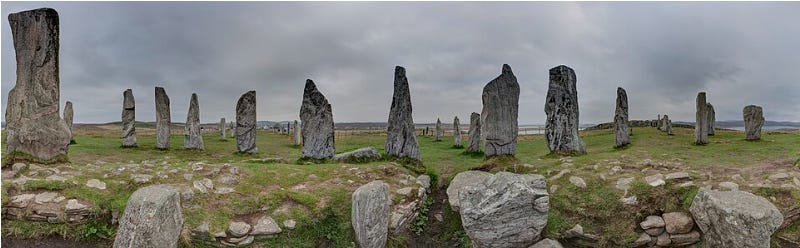
Callanish Standing Stones, Isle of Lewis, Scotland. Photo: Wikimedia Commons, CC BY-SA 4.0.
There’s also the Isle of Skye, which has the Fairy Pools, the Old Man of Storr, and that same mythic quality. And smaller islands like St. Kilda, which was evacuated in 1930 and is now uninhabited -- just ruins and seabirds. The idea of a community choosing to live on a remote island, cut off by choice, felt very St. Kilda to me, except these women chose to stay rather than leave.
I spent about an hour looking at ferry schedules and Airbnb listings on Lewis. So that happened.
4. The idea that wouldn’t leave: can the same story belong to more than one person?
This wasn’t a single Google search so much as a thread I kept pulling. The plagiarism angle, the AI angle, and even Feeney’s fictional island all circled back to the same question: who owns a story?
There's a concept in folklore studies called 'polygenesis.' It's the idea that similar stories arise independently in different cultures because humans share the same fears, desires, and experiences. Flood myths appear in Mesopotamian, Hindu, Greek, and Indigenous traditions, not because anyone copied anyone else, but because floods are terrifying and universal.
So maybe the question isn’t whether someone stole your story. Maybe it’s whether any story was ever just yours to begin with.
I don’t know. But I like that a thriller I mostly read as a palate cleanser sent me here.
My latest experience with novel induced trips down rabbit holes: I hadn't read more than a chapter of Aloha Wanderwell Takes the Wheel by Laurel Weeks Corona before I was Googling her. Was she a real character, yes she was, and her exploits on the page were only the tip of the iceberg as far as her adventurous life. I spent hours reading the book and visiting sites about Hollywood in the 1920s. Fascinating!