


Beautiful Ugly by Alice Feeney is marketed as a thriller, the kind of book you read between heavier stuff, the kind you pick up when you want to escape reality for a few hours.
And it is all of those things. But here’s what nobody told me: this book has some of the most honest, gut-level writing about love and marriage I’ve read in a long time. Not the romance-novel version where everything resolves in a grand gesture, but the real version, the one that makes you set the book down and sit with it for a while.
I gave it 4 stars for the plot. But the quotes about love? Those are 5-star sentences hiding in a 4-star thriller.
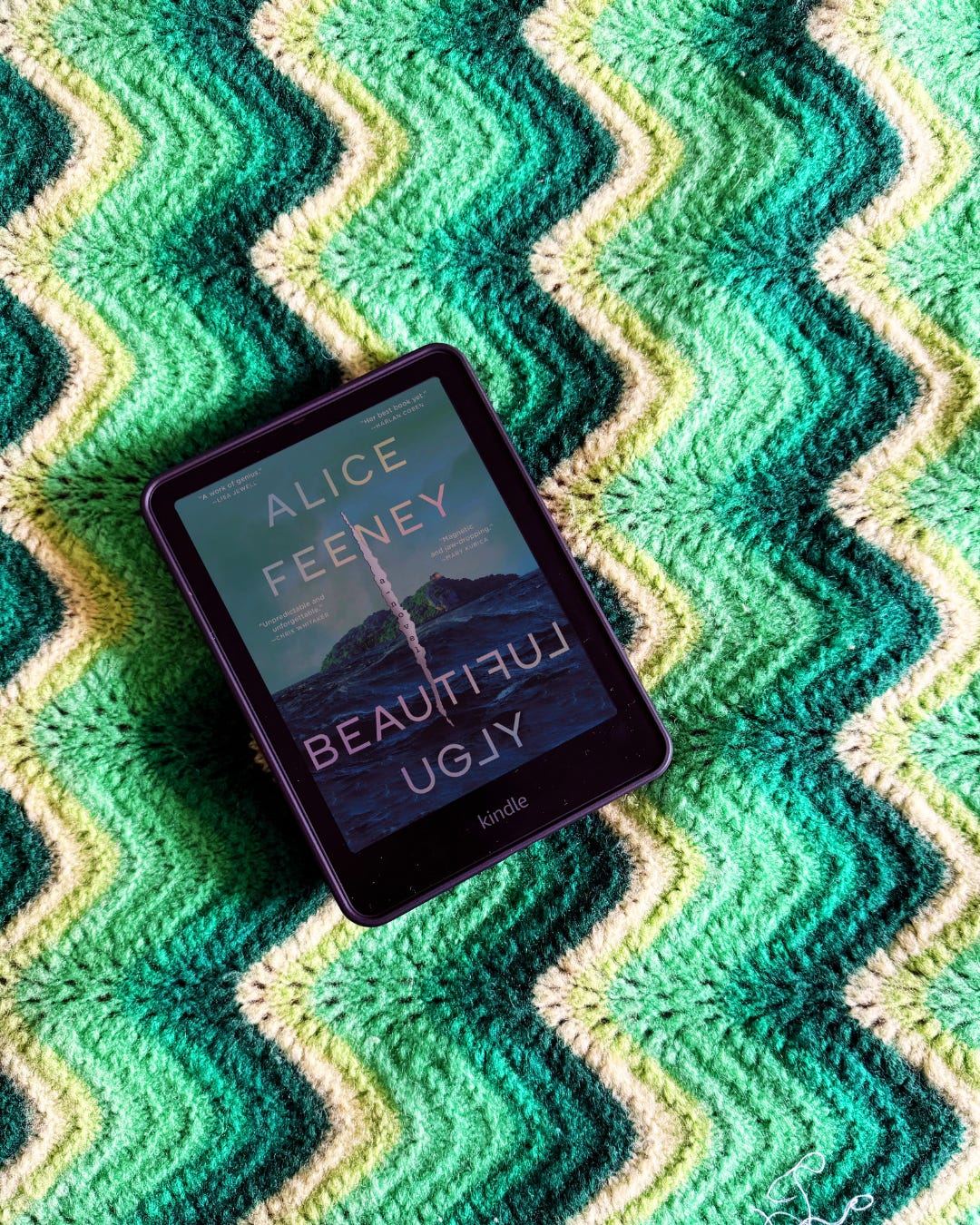
The Tapestry
“Marriage is made of a million beautiful and ugly moments stitched together into a shared tapestry of memories, all of which are viewed and remembered slightly differently, like two people staring at the same painting from opposite ends of a room.”
This one got me. Because it’s not just about marriage. It’s about every long relationship. You live through the same moments side by side, and you still walk away remembering different versions. Not because anyone is lying, but because you’re literally standing in different places, seeing it from different angles.
My husband likes to tell this story about a scar on his foot. It involves him standing at the bottom of our stairs, needing something, and me deciding to toss it down instead of walking it to him. He claims I added spin to the object so it was impossible to catch and nearly cut his toe clean off. I claim I just tossed it normal. Same moment, two completely different versions, and we’ve been telling them both for years.
It shows up in the bigger memories too. Over the years we’ve taken our kids to every kind of professional sporting event you can think of because each kid had a different obsession: one loved NFL, one MLB, another pro soccer and NBA. My husband remembers the games, the leading scorers, the train or bus we had to take to get there.
I remember the look on his face when one of the kids lost their mind over a play or player he’d been waiting for them to see. He was living inside the event. I was watching him be a father. Same stadium, same afternoon, and we weren’t even having the same experience.
And then there's the version that catches you off guard. My husband and I were bickering over something dumb at dinner one night, not a real fight, just overtired and snippier than usual. My youngest looked at us and said "you guys fight all the time." We both stopped because we genuinely couldn't remember the last time we'd had an actual fight. To us it was barely a moment, one of those minor ugly patches you don't even register. But to our son watching from the outside, it looks like a flaw in the whole thing. Same tapestry, completely different angles.
Beautiful Because It’s Ugly
The "beautiful and ugly" part is the title of the book, but it's also the truth of being with someone long enough. The beauty and the ugliness aren't separate chapters. They're stitched together, same tapestry, same thread. And sometimes the ugly is what makes the beautiful. The scar story is ugly (sorry, babe) but twenty years later it's one of our funniest stories. Sitting in the same stadium and not even having the same experience is ugly in a quieter way, but it's also proof that we each bring something different to this family. The overtired fights are ugly in the moment, but they're proof we're still in it, still building something, still close enough to irritate each other.
And then there’s the pottery shop. The female lead runs a studio called Beautiful Ugly, where she makes intentionally misshapen mugs and ceramics. There’s a whole conversation in the book about the name, about how something can be both at once. It’s not a throwaway detail. Feeney is layering the title into everything: the marriage, the art, the way this woman shapes something imperfect on purpose and calls it finished. The shop name does the same work as the quote above, just quieter. Beauty and ugliness aren’t opposites. They’re the same thing, held at different angles.
The Mismatch
“Wives think their husbands will change but they don’t. Husbands think their wives won’t change but they do.”
Short and brutal, and one of those things you read and immediately think of three couples you know, including maybe your own.
There’s no judgment in it, just observation. And the older I get, the more I think this is one of the most accurate sentences ever written about heterosexual marriage. Not because it’s cynical, but because it names the specific mismatch that creates friction: one person waiting for change that won’t come, the other blindsided by change they didn’t expect.
My husband still has to have the last word in every conversation. He uses his loud teacher voice at home because after decades in a classroom he doesn't know how to turn it off, and it drives me insane. He eats chips in the kitchen and I have misophonia so I want to leave the room every single time. I still point these things out. I still ask. But there are other things I've let go. He's snored for years, and I used to wake him up every time because it kept me up. About five years ago I bought sleep earplugs instead, and now I only wake him when the volume gets past what the earplugs can handle. That's not fixing the problem. That's just finding a way to live next to it. And I think there's something worth sitting with in that, because when you stop bringing up the things that bother you, you're not just "letting the small stuff go." You might be giving up on them changing, which might also be giving up on each other a little bit. The little things are the big things. They just don't look like it from the outside.
But then there’s the other side of change, the kind you didn’t see coming. We were babies when we got married, straight out of college, high school sweethearts who thought they knew exactly who they were marrying. I used to travel constantly for work and put in long hours when I was home, trying to manage all the household stuff on top of running a business. My husband has been a teacher, coach, and administrator over the years, which means his summers are more relaxed than mine ever were. One summer I came home from a work trip fully braced to spend the weekend catching up on chores, and the laundry was done and the kitchen was clean. No announcement, no “look what I did.” Just handled. And I realized that had become a pattern I hadn’t noticed forming.
He didn’t change because I asked. He changed because he saw what was needed and just did it. That’s not the boy I married at twenty-two.
And I’m not the girl he married either. Somewhere around COVID I stopped traveling as much for work, realized I loved being home, and slowly became a different person socially. I used to be the one who made us new friends, who brought us into groups, who said yes to every parent gathering and neighborhood thing. Then I realized I was doing most of it out of obligation, not enjoyment, and I just stopped. My husband points it out sometimes, mostly because our social circle got a lot smaller when I stopped being the connector. We get excluded from things now because I don’t care enough to keep up, and he’s supportive of me protecting my energy even though he feels the trade-off too. Sometimes he talks me into going out anyway, and I’m almost always glad he did. I make sure to tell him that, which I think matters.
When I look at pictures of that high school boy I dated or that college kid I married (both him, by the way), I can barely imagine or remember those people. It feels like so long and so many changes ago. We’ve shed so many skins since then. I like 90% of who we are now, and the other 10% we can keep working on.
I ride in a golf cart with a book now because he loves golf and I love being outside with him, even if I rarely pick up a club. I bike with him because I eventually got an ebike for the hills after I rage-quit our first ride on a regular bike and he had to come pick me up on the side of the road at the bottom of a hill I refused to go up. That’s change I didn’t expect in myself. And the fact that he didn’t laugh at me on that roadside (okay, he probably did) and just showed up with the car is the kind of love that doesn’t make it into the highlight reel but holds the whole thing together.
The Quiet Bomb
“Is being with someone who used to love you better than being alone?”
This is the quiet bomb in the book. No dramatic setup, no big reveal, just this question sitting there on the page, waiting for you to answer it.
I think at some point in a 25-year marriage, you question whether the person sleeping across from you still loves you, or if they still love you the way you love them. And I’d be lying if I said I’ve never had moments where being alone sounded great. When he leaves cupboard doors open, trims his beard over the sink and doesn’t clean it up, leaves the toilet seat up at 2 AM. In those moments my answer to Feeney’s question is yes, absolutely, being alone sounds incredible. I’ll take a rural chicken farm with a few like-minded women and never share a bathroom again.
But then I think about what I’d actually miss. My mom has been single and living alone for many years, and I’ve watched what that kind of solitude changes in a person over time. And I think about the fact that my husband is still trying. Still trying to change the things I’ve been asking him to change for 25 years. That’s not someone who used to love me. That’s someone who’s still in it.
I don’t have a clean answer to Feeney’s question. I go back and forth. I think most people in long relationships do, even if they’d never say it out loud.
The Darkest Way to Say I Love You
“I hope you die in your sleep.”
Full quote: “I hope you die in your sleep. I’ve been thinking about it lately, death, and it’s got to be the best way to go. If you truly loved someone, that’s how you’d want them to die, and I love you more than anything. So I hope you die in your sleep.”
They said that to each other every night before bed. “I hope you die in your sleep” was their way of saying “I love you.”
This one broke me. Because it’s dark and weird and also one of the most tender things I’ve ever read. It reframes love as wanting the softest possible ending for someone. Not “I hope nothing bad ever happens to you,” because we all know that’s not realistic. But “when the bad thing comes, I hope it’s gentle.”
That’s love that has looked at mortality and decided to be gentle with it instead of afraid.
My husband and I don’t have anything like that. I’ve always loved the “ditto” from Ghost, but it never caught on with us. We’re just regular “love you, goodnight” people. But reading this made me wonder if we’re missing something by not having our own version of it. So I actually want to ask: do you and your person have a weird or special way of saying I love you or goodnight? What is it?
The Warning
“People rarely know what they have until they lose it. They spend their lives searching for a better one, wanting more, needing more, blind to the fact that they already had it all. I think sometimes it’s only when something gets taken from a person that they appreciate what they had.”
This isn’t a new idea. We’ve all heard “you don’t know what you have until it’s gone.” But Feeney writes it with a specificity that makes it land differently. “Searching for a better one,” not a better life but a better person, a better version of the relationship. Always looking for the upgrade, missing what’s already in your hands.
I can’t speak to this one from experience, and I hope I never have to. But I read it and felt it in my chest anyway, which is maybe the point. You don’t have to have lost someone to understand the warning in it.
Why Does This Matter in a Thriller?
Because the best thrillers aren’t just about plot twists. They’re about people being human in extreme circumstances. And Feeney uses the mystery framework to sneak in observations about love and loss that would feel heavy-handed in a literary novel but land perfectly inside a page-turner.
You don’t expect a thriller to make you think about your own marriage. That’s exactly why it works.
Beautiful Ugly. 4 stars for the story, but these quotes are worth the whole book.
Every quote here is from Beautiful Ugly by Alice Feeney. If you want it, my Bookshop.org link supports indie bookstores and tosses a few cents my way.
What’s the memory you and your person remember completely differently? The scar story, the stadium afternoon, the fight your kid swears happened. Tell me your version in the comments, then go ask them for theirs. I’d bet it doesn’t match.
What a great essay, thank you for sharing these quotes and your reflections. I love when a book makes us think about our own lives in an unexpected way.
Wow! That first quote got me. Sometimes it's like looking at a tapestry from different angles, other times I think it's like one person is looking at the front of the tapestry while the other sees the back. Kind of cool that we can get a more complete picture by comparing perspectives, though.